Measuring Content Health: How to Audit, Score, and Optimize Enterprise Content
In enterprise environments, content doesn’t just exist—it performs.
To manage thousands of pages across teams and tools, organizations need a way to measure how healthy their content ecosystem really is.
That’s where content health scoring comes in.
What Is Content Health?
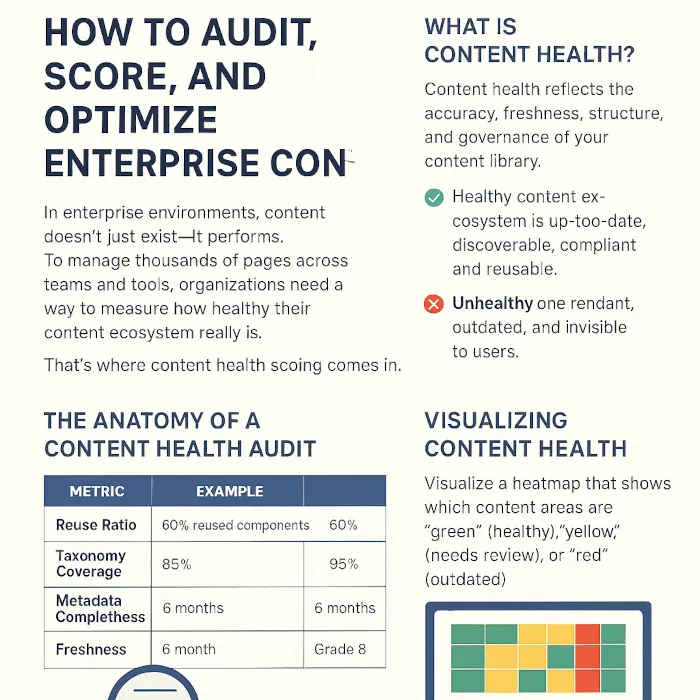
Content health reflects the accuracy, freshness, structure, and governance of your content library.
A healthy content ecosystem is up-to-date, discoverable, compliant, and reusable.
An unhealthy one? Redundant, outdated, and invisible to users.
The Anatomy of a Content Health Audit
A content audit identifies what exists, what’s broken, and what needs attention.
To make it actionable, you need metrics that quantify the invisible.
Here’s a core framework:
| Metric | Description | Example |
|---|---|---|
| Reuse Ratio | % of reused vs. unique content | 60% reused components |
| Taxonomy Coverage | % of content tagged with approved terms | 85% |
| Metadata Completeness | % of mandatory fields filled | 95% |
| Freshness | Average time since last update | 6 months |
| Readability | Average grade level / clarity | Grade 8 |
Each of these metrics ties back to business outcomes: better findability, compliance, and efficiency.
Visualizing Content Health
A simple Power BI or Tableau dashboard can turn this into a living system.
Imagine a heatmap that shows which content areas are “green” (healthy), “yellow” (needs review), or “red” (outdated).
Example structure:
- Content Type: Articles, Disclosures, FAQs
- Owner: Digital Content Team
- Health Score: Weighted composite (e.g., 85%)
- Next Review Date: Auto-calculated from Effective/Expiry metadata
When stakeholders can see content health at a glance, governance becomes proactive instead of reactive.
Automating Audits
You can automate many checks using simple scripts or API exports from your CMS.
For instance, a lightweight Python audit might flag outdated content:
if metadata['expiry_date'] < today:
    flag_for_review()
This turns governance into a measurable process rather than an endless manual task.
Using Scores to Drive Action
Content health data becomes powerful when tied to action:
- Prioritize updates for low-scoring content.
- Reward teams maintaining high health scores.
- Set quarterly goals: e.g., “Raise metadata completeness from 88% → 95%.”
In the long run, content health becomes as important a KPI as uptime or page load time.
Why It Matters
Healthy content is more than a compliance checkbox—it’s a trust signal.
When users consistently find accurate, up-to-date information, they trust your brand.
When content is outdated or inconsistent, that trust erodes instantly.
A structured, measurable content ecosystem ensures that every piece—no matter how small—works in harmony with business goals.

Robert J. Villemure is a digital marketing, e-commerce, and web development expert with over 20 years of experience. As the founder of OptimizexAI, he helps businesses across healthcare, hospitality, higher education, and e-commerce harness AI to drive growth and innovation. Previously, he led large-scale SEO and digital initiatives at Barton Associates and Wynn Encore Boston Harbor, optimizing websites, boosting engagement, and managing multimillion-dollar digital campaigns. A graduate of the MIT Sloan + CSAIL AI program, Robert specializes in AI-driven marketing, predictive analytics, and technical SEO. Through OptimizexAI, he shares insights and strategies to make AI and digital transformation accessible for businesses of all sizes. Connect with him.