The Hidden Engine of Content Findability
When people talk about content strategy, the spotlight often shines on design, UX, and storytelling. But behind every great piece of enterprise content lies a quiet hero: metadata.
Metadata—literally, data about data—is what makes information discoverable, reusable, and compliant across massive ecosystems like financial institutions, universities, or global corporations. It’s the invisible scaffolding that supports everything users see (and everything content teams manage).
What Metadata Is—and Why It Matters
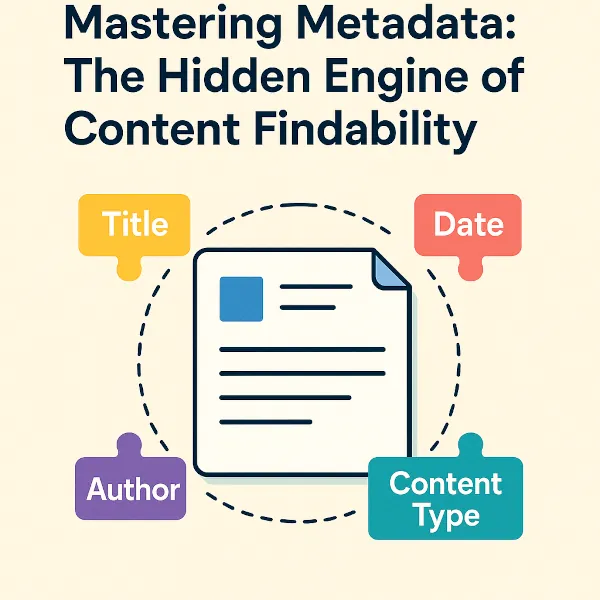
Think of metadata as the DNA of content. It describes what a piece of content is (title, author, publish date), who it’s for (audience, persona, geography), and how it should behave (effective/expiry dates, access level, content type).
In practice, metadata ensures:
- A “Retirement Planning” article for clients isn’t confused with one for associates.
- Outdated financial guidance gets flagged for compliance review automatically.
- Site search knows to group related materials together.
Without metadata, even the most expert content is invisible. With it, content becomes searchable, filterable, and governable. Metadata is at the heart of any Google web search.
The Metadata Ecosystem in Enterprise CMS
In systems like WordPress, Drupal, or SDL Tridion Docs, metadata isn’t an afterthought—it’s part of the content model itself. Each content component is associated with a schema that defines which metadata fields are mandatory and which are optional.
Picture this flow:
Content Component → Metadata Schema → Repository → Search UI
When metadata is consistent, it unlocks powerful automation:
- Content can automatically surface in portals based on topic or audience.
- Outdated materials can be suppressed without human intervention.
- Reports can quantify reuse, taxonomy coverage, and freshness.
How Metadata Supports Content Governance
Governance is about control without chaos. Metadata gives teams control by making content traceable.
For example:
- Effective Date determines when a document becomes visible.
- Expiry Date flags content for review before it becomes noncompliant.
- Owner/Author ID establishes accountability and routing.
In a financial context, this isn’t optional—it’s compliance-critical.
Common Metadata Pitfalls
Even the most robust CMS can’t fix sloppy metadata. Some recurring issues:
- Inconsistent naming conventions: “Retirement Planning” vs. “Retirement-Planning.”
- Empty fields: especially “Audience” or “Topic,” which cripple search filters.
- Uncontrolled vocabularies: when anyone can create a new tag, chaos follows.
Building a Sustainable Model
Start small and scale. Identify 5–8 core fields that every asset must include:
- Title
- Description
- Audience
- Content Type
- Effective Date
- Expiry Date
- Owner
Then, expand to specialized fields (e.g., “Compliance Approval ID”).
Create ownership for each metadata set—someone should own its accuracy. Finally, audit regularly. Metadata, like content, degrades over time.
Metadata in Action
Here’s how one piece of financial education content might evolve after a metadata audit:
| Field | Before | After |
|---|---|---|
| Title | Financial Basics | Financial Basics for First-Time Investors |
| Audience | Empty | Retail Clients |
| Effective Date | 2019 | 2025-01-01 |
| Owner | Empty | Digital Content Team |
This one update improves discoverability, compliance accuracy, and audience targeting—all without rewriting a single sentence.
The Invisible Power of Metadata
To the casual reader, it is invisible. To the content strategist, it’s everything.
It’s what ensures the right content reaches the right user, at the right time, in the right format.
When managed strategically, metadata turns chaos into clarity—and transforms content into a scalable business asset.

Robert J. Villemure is a digital marketing, e-commerce, and web development expert with over 20 years of experience. As the founder of OptimizexAI, he helps businesses across healthcare, hospitality, higher education, and e-commerce harness AI to drive growth and innovation. Previously, he led large-scale SEO and digital initiatives at Barton Associates and Wynn Encore Boston Harbor, optimizing websites, boosting engagement, and managing multimillion-dollar digital campaigns. A graduate of the MIT Sloan + CSAIL AI program, Robert specializes in AI-driven marketing, predictive analytics, and technical SEO. Through OptimizexAI, he shares insights and strategies to make AI and digital transformation accessible for businesses of all sizes. Connect with him.